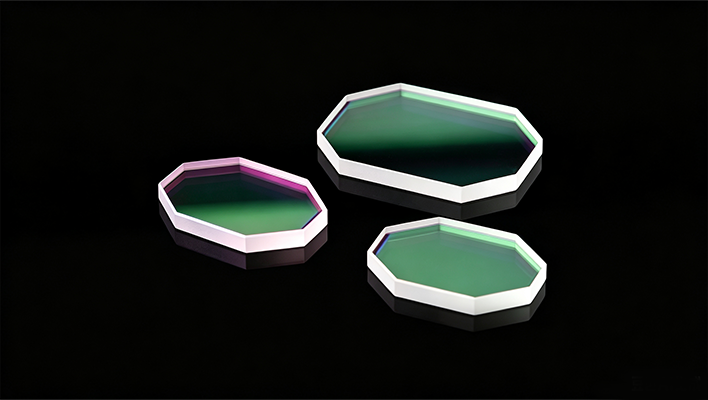
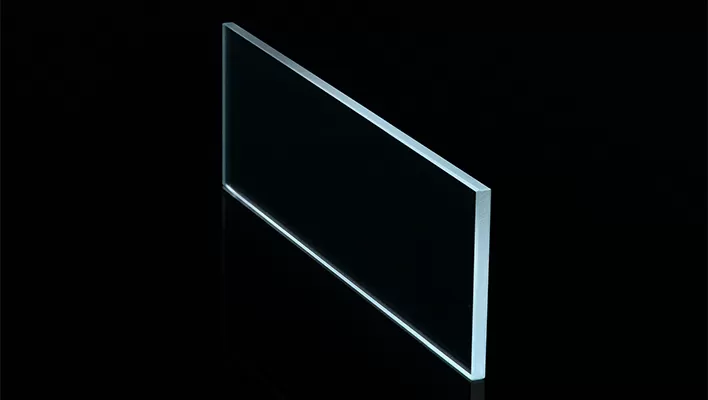
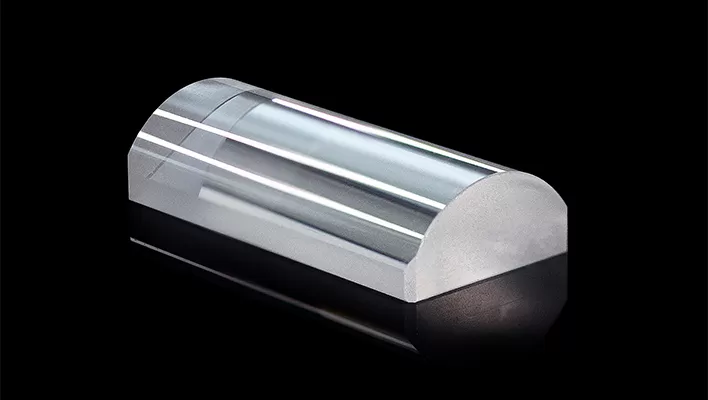
An optical prism is a transparent solid optical element surrounded by intersecting planes that are not parallel to each other. It is designed to deflect the path of a light beam or disperse light into its component wavelengths. Prisms are usually made from high-precision optical materials and are fundamental components in modern optical instruments. Due to their diverse ability to manipulate light, prisms are often categorized into different types based on their functional structure.
Based on their interaction with incident light beams, optical prisms can generally be categorized into four main types:
Dispersion Prisms: Specifically used to decompose composite light into various spectral bands. Dispersion prisms are widely used in spectroscopic instruments to separate light sources into different wavelengths for analysis and research applications.
Deflection/Reflective Prisms: Used to change the propagation direction or optical path of a light beam. A typical example is the right-angle prism, which uses total internal reflection to achieve 90° or 180° deflection of light. These prisms are commonly used in periscopes, telescopes, and binoculars to fold or redirect the optical path within compact structures.
Rotation Prisms: Used to achieve image inversion, upright image transformation, or rotation without changing the position of the optical axis. These prisms are critical in complex imaging systems for correcting image orientation.
Displacement Prisms: Used to cause lateral (sideways) translation of the optical axis while maintaining the original propagation direction of the light beam.
As high-precision optical devices, prisms provide key functions in various engineering fields, primarily in:
Prisms, based on refraction and reflection principles, can separate, redirect, or deflect incident light beams at highly precise angles. This structured control ability allows optical systems to extract specific portions of a light beam, combine multiple light sources, or direct optical paths to different sensors.
Prisms are vital components for expanding the capabilities of observation and recording devices, such as telescopes, microscopes, and high-end industrial cameras. By integrating customized prism combinations into optical systems, engineers can achieve:
Optimized image quality: Reducing aberrations and ensuring correct image orientation.
Expanded field of view (FOV): Redirecting optical paths under spatial constraints to maximize observation range.
Enhanced image clarity: Reducing light loss and outputting clear, high-resolution images by optimizing total internal reflection and related coatings.
In summary, optical prisms are key components in modern optical design, offering capabilities far beyond those of "ordinary glass blocks." Whether using dispersion prisms to decompose light into its basic spectrum or employing reflective geometric structures to guide optical paths in confined spaces, understanding prism characteristics is essential for enhancing system performance. By precise management of refraction and internal reflection, prisms continuously drive advancements in aerospace, microscopic imaging, and digital imaging industries.
Q1: What is the main difference between prisms and ordinary beam splitters?
Both can manipulate optical paths, but ordinary beam splitters typically rely on partially reflective coating interfaces to simultaneously split a single beam into multiple outputs; whereas prisms mainly use geometric refraction angles or total internal reflection to deflect or disperse the entire beam.
Q2: How does total internal reflection (TIR) work inside reflective prisms?
When light propagates within high refractive index glass and reaches the internal interface at an incidence angle greater than the "critical angle," the light will not transmit through the interface but will be 100% reflected back into the prism. At this point, the internal surface of the prism acts as an efficient ideal mirror, without the need for metal reflective coatings.
Q3: Why can dispersion prisms separate white light into different colors?
This is due to the dispersive properties of the material: different wavelengths (colors) of light have slightly different refractive indices when entering optical glass. Short wavelengths (blue/violet light) refract more strongly and have larger deflection angles; long wavelengths (red light) deflect less, spreading composite white light into a rainbow spectrum.
Q4: Can rotation prisms change image orientation without altering laser beam propagation direction?
Yes. Rotation prisms (such as Dove prisms or Pechan prism combinations) achieve image inversion or rotation via internal reflection while maintaining the central optical axis aligned from incidence to exit.
Q5: What coatings are commonly used on high-precision optical prisms?
Prisms are usually coated with anti-reflection (AR) coatings on the incident and exit surfaces to increase transmittance and reduce ghosting. For surfaces where geometric conditions cannot achieve total internal reflection but still require reflection, high-reflective dielectric coatings or metal coatings (such as aluminum, silver, or gold) are applied.
For an in-depth understanding of optical glass material properties and prism manufacturing tolerances, refer to RP Photonics' "Encyclopedia of Laser Physics and Technology."