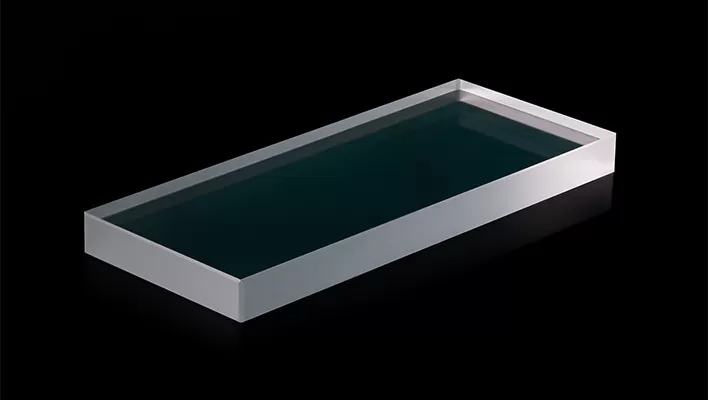
Although cylindrical lenses are not as well-known as common spherical convex or concave lenses, their unique capabilities make them indispensable in many high-precision applications. This article introduces the basic principles, common types, manufacturing materials, and major industry applications of cylindrical lenses.
A cylindrical lens, as the name suggests, has at least one surface shaped like a part of a cylinder. Unlike spherical lenses that focus or diverge light uniformly in all directions, cylindrical lenses are specifically used to guide light along a single dimension. Due to this unique ability, cylindrical lenses have irreplaceable value in scenarios where standard lenses cannot meet precision requirements.
The unique geometric structure of cylindrical lenses allows them to focus light from a source (such as a laser) into a clear line rather than a point. They can control the beam in one dimension—either compressing or expanding the beam cross-section—thus having high applicability. Their design enables engineers to precisely bend and shape light to meet the stringent requirements of specific optical systems.
Depending on application requirements, common structural types of cylindrical lenses include:
Plano-Convex Cylindrical Lenses: One side is flat (plano), and the other side is outwardly curved (convex).
Plano-Concave Cylindrical Lenses: One side is flat, and the other side is inwardly curved (concave).
Bi-Convex Cylindrical Lenses: Both sides are outwardly curved.
Bi-Concave Cylindrical Lenses: Both sides are inwardly curved.
Meniscus Cylindrical Lenses: Shaped like a crescent, with one convex and one concave side.
Crossed Cylindrical Lenses: Have a special crossed cylindrical structure, capable of controlling light simultaneously in multiple axial directions.
Asymmetrical/Custom Cylindrical Lenses: Designed with irregular shapes to meet non-standard, customized specifications for clients.
Cylindrical lenses play a key role in the transformation and correction of beams in advanced optical industries, with typical applications including:
Astigmatism Correction: In ophthalmology and imaging systems, aligning the lens with the astigmatism axis can converge light onto a single plane, effectively correcting distortion or blurred imaging.
Laser Beam Shaping: Laser diodes typically output a highly divergent and asymmetrical elliptical spot. Cylindrical lenses can shape it into a more balanced circular beam to enhance beam quality.
Spectroscopy: Used in spectral systems to modulate the spatial and spectral characteristics of light, such as matching and aligning optical paths within grating systems.
Laser Line Scanning: Converts a regular laser beam into a uniform line spot, which is crucial for 3D measurement, non-contact inspection, and automated quality control.
Advanced Microscopy: In confocal and fluorescence microscopy systems, cylindrical lenses can shape excitation laser beams and correct optical aberrations, significantly improving the signal-to-noise ratio (SNR), thereby enhancing overall system performance.
Cylindrical lenses are foundational components in modern photonics and vision correction for achieving "one-dimensional beam manipulation." By focusing or expanding light along only one axis, they compensate for the shortcomings of traditional spherical optics, enabling laser beam rounding, clear line light generation, and precise astigmatism adjustment. Whether integrated into medical imaging equipment, high-speed automated manufacturing scanning systems, or used in specialized laser components, understanding their geometric structure and optical behavior can help achieve optimal optical system performance.
Q1: What is the main difference between spherical lenses and cylindrical lenses?
Spherical lenses have symmetrical curvature across their entire surface, thus focusing or diverging light uniformly in all directions, forming a single focal point. Cylindrical lenses have curvature only along one main axis, so they can only focus or expand light in a single dimension, forming a focal line.
Q2: What are the "optical axis" and "cylinder axis" in cylindrical lenses?
The "cylinder axis" refers to the direction where the lens surface remains uncurved and straight; light passing along this axis does not bend. The "optical axis" (also understood as the curvature axis) is perpendicular to the cylinder axis; light in this direction is subjected to the full refractive force of the lens, bending or focusing.
Q3: Why are cylindrical lenses crucial for semiconductor laser diodes?
Semiconductor laser diodes naturally emit highly asymmetrical and divergent beams, shaped more like elongated ellipses rather than circles. Cylindrical lenses are often used in pairs to selectively compress or expand the beam in one axis, shaping the beam into a balanced, symmetrical profile.
Q4: Can a plano-convex cylindrical lens generate a laser line for scanning?
Yes. When a collimated laser beam passes through a plano-convex cylindrical lens, the lens compresses the beam along its curvature direction while minimally altering the light path in the straight direction, projecting the beam into a uniform, clear line. This is a standard practice in 3D scanning and barcode reading technologies.
Q5: How do cylindrical lenses help correct human vision?
Astigmatism usually results from irregular corneal or lens shapes, leading to different curvatures in different directions. Cylindrical lenses used in prescription glasses provide additional refractive power in only one specific meridian direction to counteract the natural asymmetry of the eye, ensuring light precisely focuses on the retina.
For further understanding of the geometric mathematical principles and optical component design methods for laser line generation, refer to the complete technical documentation at Edmund Optics' technical resource center.