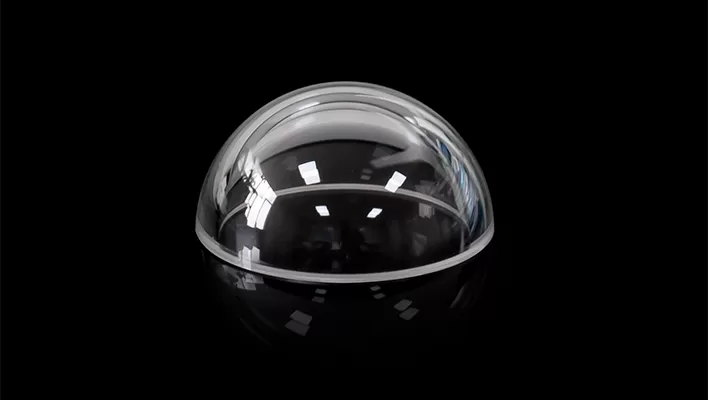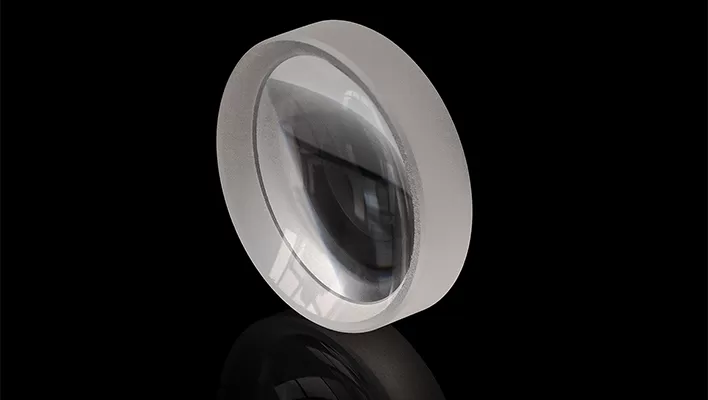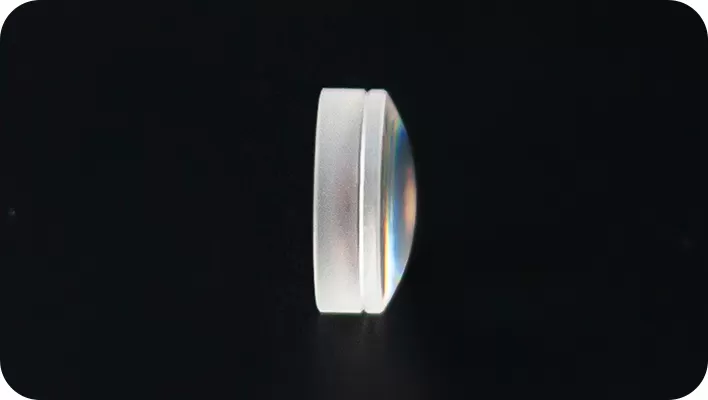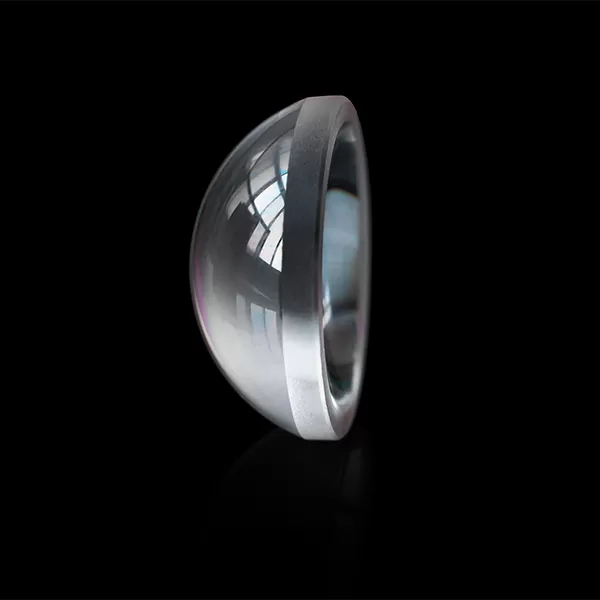
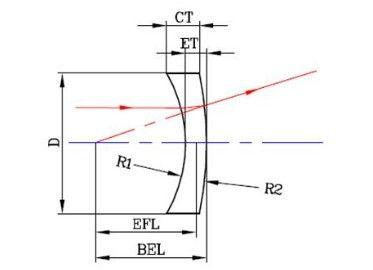
Meniscus lens means that one side of the lens is concave and the other side is convex; the focal length can be positive or negative; the meniscus lens can correct chromatic aberration, usually used as a corrective lens, and can also be used as the condenser of the lighting system. It is also possible to choose a suitable thickness. There is an achromatic effect.

Example with BK7 material: These N-BK7 biconvex lenses are available uncoated or with one of five antireflection coatings (-A, -AB, -B, -C, or -D), which reduce the amount of light reflected from each surface of the lens (see the Selection Guide table below for coating option). Since approximately 4% of the incident light is reflected at each surface of an uncoated substrate, the application of an AR coating improves transmission, which is important in low-light applications, and prevents the undesirable effects (e.g., ghost images) associated with multiple reflections. Having optics that are AR coated on both surfaces is particularly desirable for applications utilizing multiple optical elements. Please see the Graphs tab for additional coating information.
| N-BK7 Biconvex Lens Selection Guide | ||
| Coating name | wavelength band | 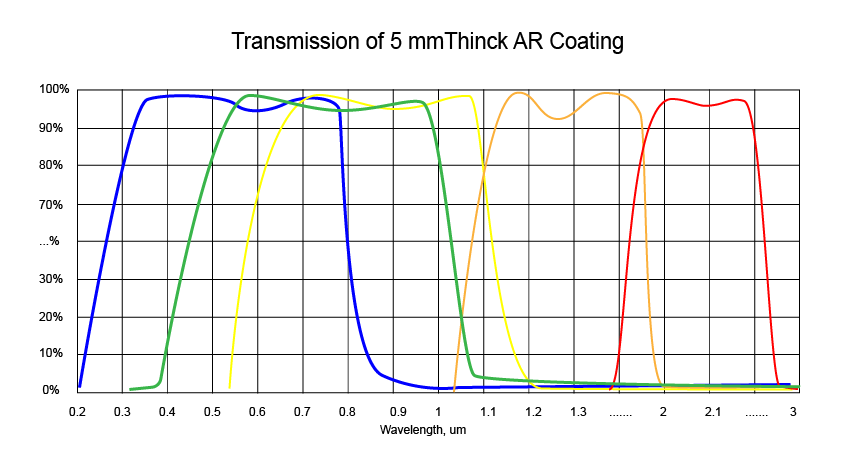 |
| Uncoated | Uncoated | |
| A Coating | 350nm-700nm | |
| AB Coating | 400nm-1100nm | |
| B Coating | 650nm-1050nm | |
| C Coating | 1050-1700nm | |
| D Coating | 1650nm-3000nm | |