Recently, the Xi'an Institute of Optics and Precision Mechanics (XIOPM) of the Chinese Academy of Sciences, in collaboration with the National Institute of Scientific Research (INRS) of Canada and Northwest University, has made significant progress in the field of compressed high-speed imaging. The relevant research results were published in *Ultrafast Science*. The co-first authors of the paper are Dr. Li Xing and Dr. Wang Siying from XIOPM, and Dr. Chen Changheng from Northwest University. The corresponding authors are Researcher Bai Chen and Researcher Yao Baoli from XIOPM, with XIOPM being the first contributing institution and corresponding unit.
The core challenge of compressed high-speed imaging lies in the high-fidelity reconstruction of dynamic sequences from complex inverse problems. Traditional deep learning methods typically rely on large amounts of training data and generally suffer from limited generalization capabilities and the introduction of artifacts. Existing physics-enhanced frameworks are mostly limited to single-task priors, making it difficult to effectively address the complex imaging problems caused by multi-dimensional interference such as noise and inter-frame crosstalk in ultrafast imaging scenarios.
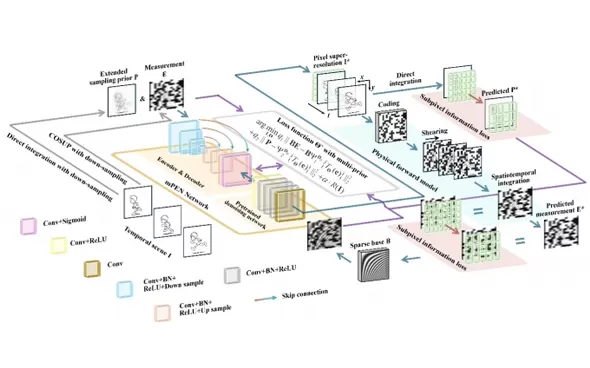
To address this, the XIOPM research team proposed a multi-prior physics-enhanced neural network (mPEN) imaging framework (as shown in Figure 1). The team innovatively integrated multiple prior information, including photoluminescence dynamics physical models, extended sampling priors, sparsity constraints, and deep image priors, into a non-training neural network. Through the synergistic correction of multiple complementary priors, the framework effectively suppresses reconstruction artifacts, corrects spatial distortions, and improves spatial resolution, exhibiting strong robustness, especially under low-photon conditions.
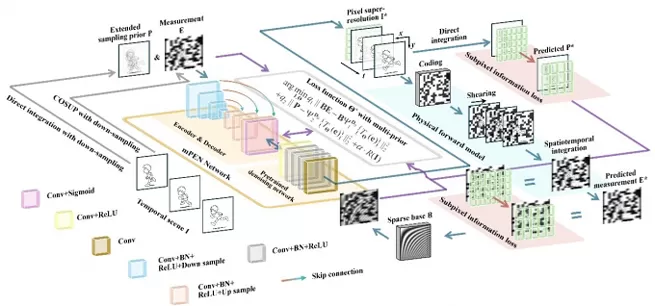
Figure 1. mPEN-sCUPLI deep learning network architecture. This framework integrates physical models, extended sampling priors, sparsity constraints, and deep image priors, addressing the instability of traditional methods.
Based on this, the research team further constructed a compressed high-speed imaging system based on dual-path synchronous acquisition and multi-prior physics-enhanced deep learning fusion (as shown in Figure 2).
The system uses a pulsed laser as the excitation light source and loads a pseudo-random pattern onto the dynamic scene using a digital micromirror device (DMD) for spatial encoding. The optical signal of the dynamic scene is divided into two paths: in the encoding path, a galvanometer scanner converts temporal information into spatial shear displacement, which is captured by a CMOS camera; in the prior sampling path, another synchronized CMOS camera directly acquires the unencoded integrated image of the scene. The system achieves precise synchronous control of the light source, galvanometer, and dual cameras through coordinated scheduling using a digital delay generator and a signal generator. Ultimately, this system, combined with AI-enabled image reconstruction methods, achieves high-fidelity, high-speed dynamic imaging while maintaining high spatial resolution.
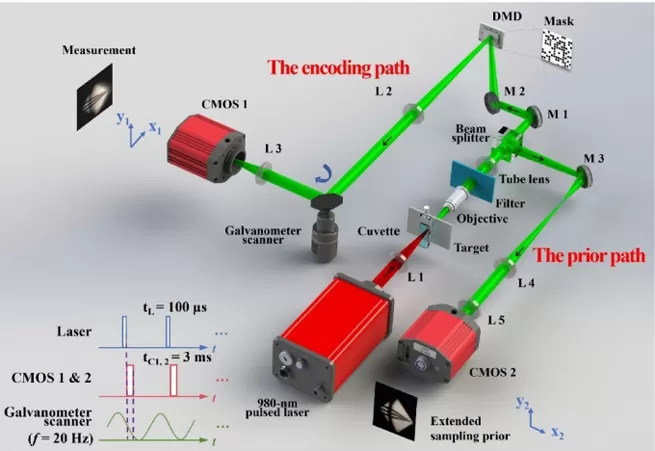
Figure 2. Optical path of compressed high-speed imaging based on multi-prior physics-enhanced deep learning.