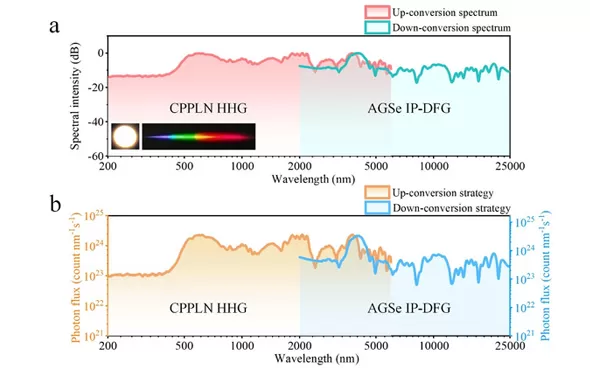
A new strategy based on "nonlinear frequency up- and down-conversion synergy" pumped by mid-infrared femtosecond high-intensity lasers has been proposed, successfully developing an ultra-flat full-spectrum white light pulsed high-intensity laser covering seven octaves from 200-25000 nm, with a pulse energy of 1 mJ and a spectral flatness of 17 dB.
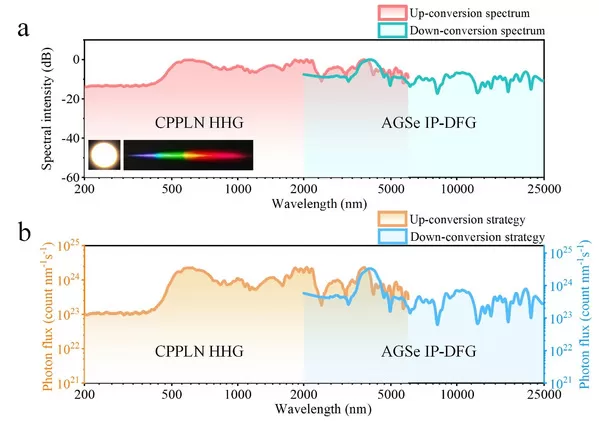
Recently, Professor Li Zhiyuan's team at South China University of Technology, in collaboration with Academician Li Ruxin's team at the Shanghai Institute of Optics and Fine Mechanics, Chinese Academy of Sciences, creatively proposed a new strategy based on "nonlinear frequency up- and down-conversion synergy" pumped by mid-infrared femtosecond high-intensity lasers. They successfully developed an ultra-flat full-spectrum white light pulsed high-intensity laser covering seven octaves from 200-25000 nm, with a pulse energy of 1 mJ and a spectral flatness of 17 dB. The relevant results were published in the top international optics journal, Light: Science & Applications.
From electron transitions within atoms to molecular vibrations between atoms and solid lattice vibrations, different microscopic processes span different characteristic wavelength ranges from deep ultraviolet to far infrared. For over 60 years since the birth of the laser, the scientific community has been pursuing a laser light source that can cover the entire spectrum to simultaneously observe these microscopic processes with vastly different energy scales. However, traditional laser light sources have limitations such as narrow spectra, insufficient energy, or low flatness, failing to simultaneously meet the stringent requirements of broad spectrum, high pulse energy, and high flatness.
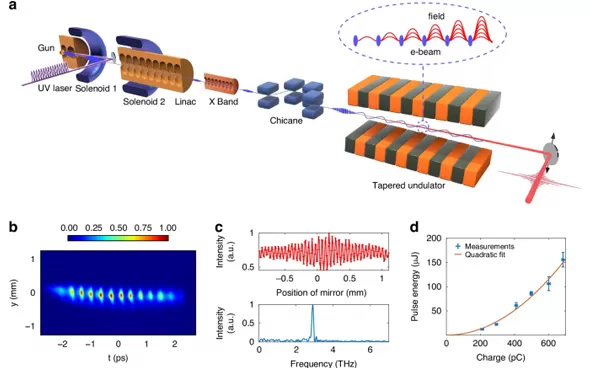
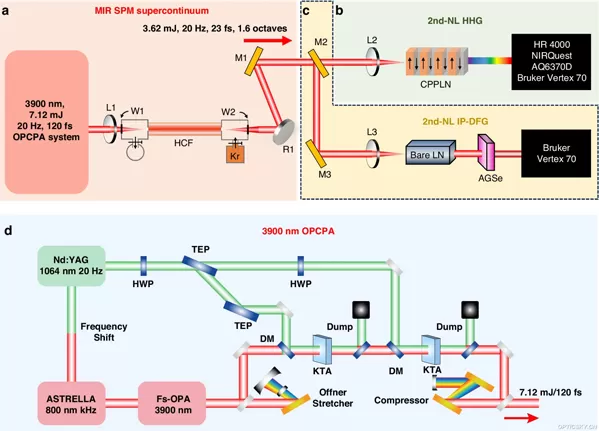
The full-spectrum white light high-intensity laser source proposed in this study breaks these limitations and is expected to create a new paradigm of "single-source full-spectrum, synchronous snapshot" laser spectroscopy, opening up new avenues for high-speed spectroscopy and pump-probe ultrafast spectroscopy techniques, and opening up broad prospects for basic scientific research in physics, chemistry, materials science, and biology, as well as application fields such as biomedical imaging, environmental monitoring, and industrial inspection. System Layout Schematic
Nonlinear Frequency Up- and Down-Conversion Synergistically Achieve High-Performance Deep Ultraviolet-Far Infrared Full-Spectrum White Light High-Power Laser
This white light laser system utilizes a 3.9 μm mid-infrared laser as a bridging light source. Through an up-conversion process, the short-wavelength boundary is extended to the 200 nm deep ultraviolet region, and through a down-conversion process, the long-wavelength boundary is extended to the 25 μm far-infrared band. The team's innovatively designed chirped periodically poled lithium niobate (CPPLN) crystal simultaneously generates 2nd to 12th order higher harmonics, achieving an up-conversion module conversion efficiency of 40% and an output energy of 1.45 mJ; the cascaded LN-silver gallium selenide (AGSe) crystal architecture of the down-conversion module achieves a conversion efficiency of 18% and an output energy of 0.75 mJ. The overall technical indicators far exceed those of similar supercontinuum laser devices.
The photon beam intensity of the entire system is 7-8 orders of magnitude higher than that of synchrotron radiation devices, allowing a single laser beam and a single laser pulse to simultaneously detect five energy scale physicochemical processes: deep ultraviolet electron transitions, visible light electron excitation, near-infrared and mid-infrared molecular vibrations, and far-infrared lattice vibrations.
Dr. Hong Lihong, a postdoctoral researcher jointly trained by South China University of Technology and the Shanghai Institute of Optics and Fine Mechanics, Chinese Academy of Sciences, is the first author of the paper. Professor Li Zhiyuan of the School of Physics and Optoelectronics, South China University of Technology, and Academician Li Ruxin of the Chinese Academy of Sciences are the co-corresponding authors. Professor Li Zhiyuan has long been engaged in theoretical, experimental, and applied research in micro-nano photonics, nonlinear optics, laser technology, topological photonics, and quantum physics.