The research team at the High-Power Laser Physics Joint Laboratory of the Shanghai Institute of Optics and Fine Mechanics, Chinese Academy of Sciences, has achieved ultra-flat wavefront sensing and measurement based on photon sieve self-interference technology, solving the problem of interferometric measurement of weakly distorted wavefronts.
Recently, the research team at the High-Power Laser Physics Joint Laboratory of the Shanghai Institute of Optics and Fine Mechanics, Chinese Academy of Sciences, achieved ultra-flat wavefront sensing and measurement based on photon sieve self-interference technology, solving the problem of interferometric measurement of weakly distorted wavefronts. The relevant research results were published in Optics and Lasers in Engineering under the title "Micro-defocus photon-sieve radial-shearing interferometer for ultra-flat wavefront sensing".
Interferometry plays an important role in various wavefront measurement techniques, and high-precision interferometry has greatly promoted the development of different disciplines. Different optical path structures have different resistance to external interference. Compared with multi-optical path interference structures, the common-path structure of self-interference has strong robustness and excellent anti-interference capabilities. The interference fringes produced by weakly distorted wavefronts change very little, resulting in a very low signal-to-noise ratio of the interferogram, making high-precision measurement difficult.
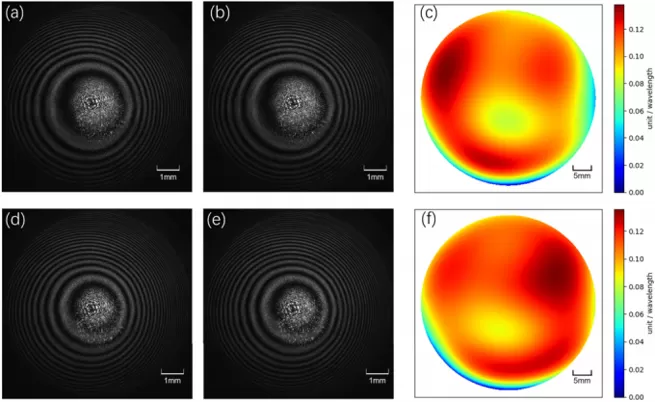
Interferograms of weakly distorted wavefronts through cascaded photon sieves: with object (a,d), without object (b,e), wavefront gradient (c,f)
Based on previous research on photon sieves, the research team introduced a spherical wave carrier frequency into the interference signal through a micro-defocused cascaded photon sieve, causing the weakly distorted wavefront to produce strongly varying interference fringes at the recording position, which are then recorded by a photodetector. Finally, the wavefront is reconstructed using interferogram demodulation technology. Figure 1 shows the experimental interferograms collected at two different times (a,b,d,e), and the corresponding wavefront gradients are (c,f). Figure 2 (a,b) shows the reconstructed wavefronts from the two experiments, which are consistent with the ZYGO measurement results (c). This research was supported by the National Natural Science Foundation of China, the Strategic Priority Research Program of the Chinese Academy of Sciences (Category A), and other projects.